Der gror ikke muse på rullande stein

It was a red eye flight out of Stewart International Airport in Newburgh, New York to Bergen, Norway on a long weekend in August that became my first real solo travel adventure to Europe. I was working like a dog for an ad agency and rarely took time for myself in my late twenties. Norwegian Air had a sweetheart deal out of a smaller airport, and having been to Oslo on a nearly 24 hour layover from an Oktoberfest trip with some friends the autumn prior, I took the plunge
It was not my first time traveling abroad, nor was it my first time in Norway, but it was my first trip outside ofthe US and Canada alone solely for the sake of travel. I was teased the year prior while after traveling with two friends from Frankfurt and ultimately to Munich for Oktoberfest. I had to depart the trip a few days earlier due to my work schedule. My connecting flight out of Munich took me to Oslo for a half of a day and forever spoiled me and made me realize that I can handle traveling to multiple countries on my own and having learned conversational German, also having the confidence to at least understand the basic language and some culture of where I go.
Summer time is excellent for the long weekends to travel solo because many offices here in the United States offer “Summer Fridays” where you can have a Friday off or be able to get out of the office earlier than the usually 5 to 6 m closing time. I booked a red eye a few months prior, scouted out Bergen, popped in Norwegian audio CDs to help learn basic Bokmal (standard or common Norwegian) and the clock started to count down. Jeg føler også at norsk og svensk er litt enklere enn et annet språk som jeg studerte, tysk. Gud velsigne meg, jeg har startet Mandarin kinesisk (uff da!).
About Bergen
Bergen has an interesting history on Norway’s southern coast that is protected by an island from the North Atlantic that provided shelter and respite for seafaring merchants. Over seven centuries ago, the local king established Bergen as a trading port. From the 13th century onward, it developed Germanic community from the Hanseatic League of traders and craftsmen supported by local Norwegians to help the fish and forestry goods from Norway reach the rest of Western Europe. The name of the city owes itself to these German tradesmen who dubbed the old town where the Harbor is located as Bryggen (the dock). The Norwegians will refer to is as Tyskebryggen (The German dock). Many of the old town surrounding Vagen Harbor retains much of the Medieval character and the city has taken great lenths to preserve its history. Many of the trading posts are now shops, restaurants and other tourist attractions today. The streets retain much of its cobblestone design and Saint Mary’s Church dates to the 1140s. However, some of the old merchant homes and shops were lost in a fire in 1955. The Bryggen Museum now stands in the place of the ashes of that catalymetric fire as an ode to Bergen’s commercial and cultural past. I can attest that the fire did not damper Bergen’s rich history.
The city today has expanded considerably as it is Norway’s second largest city, only behind Oslo. It is now home to 250,000 residents and hosts some of Norway’s most sought-after tech and financial industries, universities and arts community. In 1820, Oslo became the capital and Norway’s most populace city, and as a result, Bergen retains considerable economic and cultural influence in Norwegian life. In the 19th century, Bergen was the artistic center of the nation as famous paints like Edward Munch who is famous for The Scream, and noteworthy composers. The relatively small size and yet densely rich history, culture is what makes Bergen an excellent short strip for several nights. Economically, Norway is very vibrant and boasts one of the highest standards of life standards in the world. The currency is the Norway Kroner, which at the time was trading around 11 to 12 Kroner to the US Dollar. Shipping, fossil fuels, fishing, forestry, and high-tech manufacturing are major industries in southern Norway. Bergen is surrounded by immense natural beauty as it sits between several mountains and foothills that are accessible by foot and rail, the coast and is referred to as the “Gateway to Fjord Country.” Let’s wander a little bit and find out why.
A Blend of Modernity and History
Arriving to Bergen’s city center where I stayed (I highly recommend the Thon’s Bristol Hotel in the city center) was very accessible from the airport and with 90 kroner, you can get a bus that transports you directly to the Torgalmenningen, which is the large square in the city center that is a five minute walk to the harbor where Bergen’s main commercial and retail district resides. The old harbor is a five minute walk from Torgalmenningen city center. From here Bergen’s history and culture comes alive like an Edvard Munch portrait. (Munch’s more famous works are on display in Bergen’s art galleries).
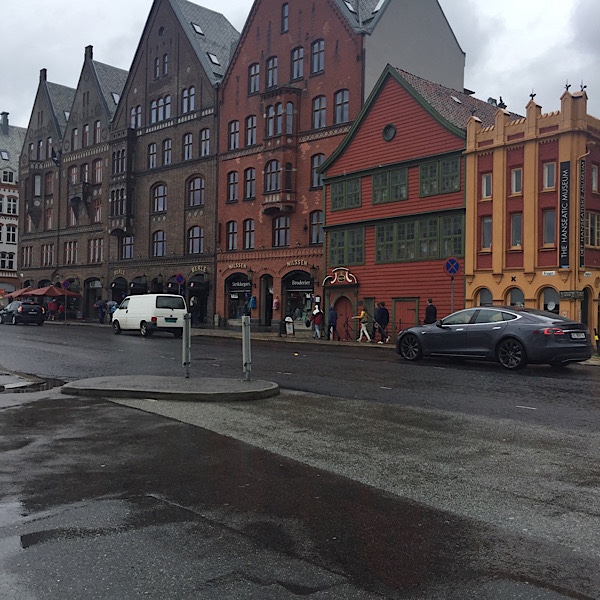
Upon entering the harbor area, three sites will immediately draw your eye. The Hanseatic wood trade houses line the harbor as a symbol to the rich trade and mercantile history of Bergen’s past with vibrant reds, yellows and white painting and décor. Some of the buildings date back to the 1700s or have been restored to as realistically era appropriate after several fires (one as recently as the 1950s) destroyed some structures throughout Bergen’s history. The harbor itself acts as the dividing point between modern Bergan and historical and artistic side of town, and the eye and scents catch the nose immediately to the restaurants, pubs, cafes, and the outdoor fish and farmers market that surround the harbor. The third and final immediate thing one will notice is the natural beauty that surrounds the city whether be it the harbor itself, or the mountains and rolling hills that surround the city. Many of these mountains and foothills are accessible by footpath or light rail.
Bryggen consists of 62 wooden buildings along the wharf that accentuates Bergen’s distinctive history. It is designated by UNESCO as a world heritage site. Some of the buildings today are now used as museums and art galleries, and are either gratis or offer a low cost while experiencing some of Norway’s finer culture and history, Most of the wooden wharf houses are shops and eateries today and is a great way to spend an afternoon. At the end of the harbor is Bergan’s fish market where you can taste fresh north Atlantic seafood, local arts and crafts, and other local farm good and cured meats. The salmon and cod plates are exceptionally noteworthy and are cooked on premise. You will also find more interesting faire including grilled whale, and cured reindeer and moose (alg!) cured meats. The nearby restaurants also offer vegan friendly alternatives for those who prefer meat and dairy free diets. The coffee and tea really stood out to me, as I am a fan of stronger coffees and black teas.

Just past the wharf, heading up the hill Bergen’s quaint shops line the cobble stone streets. Many retain an old charm of 18th and 19th century Norway. There are sites here that predate that such as St. Mary’s Church that was constructed in the 12th century. It is not as well known as the famed wooden staved churches of Norway, or as notorious as Notre Dame or Westminster Abbey, but it retains the style of the grand cathedrals while showcasing its distinct pragmatic design. Nearly as old is the 1240 constructed Bergenhus Fortress that served as the seat of government in medieval Norway and the King’s court. It is a large yet simplistic design designed for harbor defense. It is the largest secular building in historic Bergen.
The harbor is a deep-water port that acts as the gateway to Fjord country and offers many different boating options. I took a half day ferry that sailed up Ostenfjord and the Seven Sisters Waterfall on a high-speed ferry. As the boat whips by the fjords and Atlantic coast, glimpses of Norway’s modernity and natural beauty can be witnessed. The Nordhordland Bridge Is a testament to Norway’s mastery of civil engineering as it serves as the world’s largest free-floating suspension bridge that connections Norway’s coastline and outer islands. High cliffs, forests and waterfalls adorn the fjord laden coast line. Intermitted between the falls and cliffs are rustic villages on the water or sparse farmhouses. The apex of these cruises will take you to stunning waterfalls not dissimilar to a Lord of the Rings or Game of Thrones style landscape and ends at the picturesque village of Mo in Modalen, Norway. It is what you expect to see on a postcard or a painting if Norman Rockwell painted Nordic landscapes instead of North American ones. With such scenery, it is easy to understand why Norway ranks as one of the happiest nations in the globe with all of its natural vistas.


After a very leisure and brisk cruise into Ostenfjord, one can walk off their sea legs at the nearby mountains that border Bergen’s city limits. Right around the corner and past some very delicious cafes (Norwegian gourmet coffees and espressos are notably strong) one can climb or take a rail up Mt. Fløyen. A useful and more cost-effective tip is that the rail tickets can be purchased at the nearby cafes and bistros often cheaper with a purchase of coffee or tea. I elected to start walking up the 35 to 40 flights of stairs up the path ascending Mt. Fløyen having missed the rail stop. I inadvertently opted for the health conscience option, and it was worth it. The path up is very scenic as you get very panoramic vistas of Bergen’s cityscape, harbor and surrounding landscape that juts into Fjord Country.
The path isn’t a full-scale rock-climbing hike and is doable if you have the energy to scale 40 flights so stories. there is plenty of small streams, waterfalls and plant life not too dissimilar from the Pacific Northwest for those who have been to Seattle or Portland. The climb is rewarded with breathtaking views o greater Bergen and a bar and bistro perched atop the mountain top, signaled by a large Norwegian flag. It is a great way to relax with a bottle of Hansa Pilsner, one of Norway’s more widely distributed beers, and take in the fresh air and inspiring views. My recommendation is to walk up if able and take the rail down. The foot of the mountain stop is a five-minute walk from Bergen Harbor. Near it is St. Mary’s Cathedral.
Trekking into the Garden of the Gods
After a few nights in the city, I often opt, and urge, venturing into the countryside and smaller villages to get a better experience of both a country’s culture and natural beauty. This is particularly accentuated in Norway, whose coastline is a majestic array of mountains, fjords and inlets with charming towns and high-tech roadways connecting travelers up and down the Atlantic coast. After renting a BMW (which is a lot cheaper being a demotic European car) I took the E16 highway approximately 180 to 200 km to Flam and Gundvagen, which translates to Garden or Valley of the Gods.
The two to three-hour drive was perhaps the least stressful and quickest two to three hours I ever spent driving. The traffic is minimal in August and the scenery is astonishing. The trip takes one through noteworthy towns like Voss (famous for hits bottled spring water) Vaksdal, Dalekvam, and Stanghelle. There is always a Hell, Norway that is very charming and lends credence that even Hell in Norway is heaven on earth and justification of Norway’s high ranking in global happiness indices. If one needs a pit stop to stretch their legs and get a quick snack, the Town of Vangssvanet has moss covered roofed restores and hot dog stands overlooking a lake and snow-covered mountains even in August. You are then less than a third of the way to Gundvagen and Flam. Along the way, the closer you get t Naeroyfjord where Gundvagen resides, the journey presents itself with many waterfalls, mountains, tunnels and inlets.
Flåm and Gundvagen are separated by a tunnel that extends maybe 20 km. Conversely, a ferry that arcs around the fjords will also connect the tow towns. Flåm is the more active and larger of the two communities and hosts several art galleries, fine dining and a very good microbrewery. Gundvagen is a very small community of maybe 200 individuals, but it is known for two major attractions, it’s natural beauty and its Viking history. There is a small village that serves as a Viking reenactment for those curious about how Vikings lived in their daily lives circa the 10th century. The village is at the end of a valley and the end of Naeroyenfjord. The steep valleys create a green maritime environment fed by Norway’s tallest waterfall within view of my hotel that was an old post office converted to a guest house.
Gundvagen and Flåm offer much more in terms of enjoying nature and the great outdoors. There are many hiking trails that will take you up and down the fjord slopes and to waterfalls and cliffs overlooking fjords. It is a great spot for kayaking and tuning out the din of the modern world. Be sure to pack a rain ready coat and a sweater. Even in August, the temperature in the fjords can drop to 40-45 degrees Fahrenheit and weather can change drastically from sunny to a quick chilly rain. Dress and prepare accordingly.
Concluding thoughts
Norway immediately installs a lasting impression with its cultural and ecological beauty and resilience. The landscape is diverse and every few miles will look different than the previous miles. It is a healthy and economically vibrant society with high employment and high salaries. With that, comes relatively high costs of living. Food and drink at times could be expensive in Norway. For me, it did not feel expensive given the fact I live near New York City, where I experience a high cost of living daily. Food can cost you $20-$30 a plate for a dinner and beer can cost over $8. Hotel and board weren’t not expensive, and airfares at the time were very affordable relatively speaking. I also benefited from a strong US dollar relative to the Norwegian kroner.
When looking for a recommendation for traveling through Norway, keep cost and budgeting in mind if you need to watch every dollar. In upcoming posts, I will offer general recommendations to travel on a budget. On average, the US Dollar paces between 10 to 12 NOK (Norwegian Kroner) in recent years. It will help reduce the cost to a degree. Using public transit like buses and light rail will also help keep costs down. Norwegian cities like Oslo and. Bergen are very pedestrian and walking friendly, so hotels a few blocks away from the center could end up yielding good savings as well. One does not need to learn Norwegian, but it is always helpful if one attempts a few pleasantries and basics. It will impress Norwegians if du snakker litt Norsk. If you know Swedish, Icelandic or Danish, you will be able to decipher Norwegian. All of the Nordic countries have robust education where several foreign languages are taught, including an American/Canadian style English. It is very difficult to determine if someone is a native Norwegian if they are speaking to you without disclosing personal information. The accents and manner of speaking are very close to American English. Food will be the most expensive part of a trip to any Nordic state. Additionally, it is wise to research the weather at the time of the year you intend on visiting. Most of Norway is on the Atlantic coast, along the jet stream. As a result, it will see varied weather throughout the day. It is not out of the normal for quick and cold rain storms to swing into the region for an hour or two before sunny skies clear up. Bergen is the most the rainy part of the country, though it will experience it’s good share of sun and decent weather.
My final recommendation is not to spend all your time in the city. Norway’s country and coastline is exceptionally wonderful. I haven’t seen or experienced coastlines like it anywhere else with the high fjord cliffs and inlets that can cut several hundred miles inland and breakup the landscape with high peaks, water and valleys. The fjords are meant to be seen, whether it is by foot, driving, taking the train or ideally kayaking or sailing. There are many small towns at the ends of the fjords and in the valleys that provide unique Nordic country, and the people are very friendly. To travelers as most of these villages and towns are quite small. OT save on car rental coasts, there are May train, bus and boat tours that could be reserved in the large cities like Oslo, Bergen and Trondheim that will tour the fjords. The Flambana or Flam Railway is considered the most scenic train ride in the world, though the Swiss Alps and Japan’s bullet train are worthy contenders for that title. This rail stops in Bergen and Oslo. For a solo traveler like myself, three night and four days certainly provided enough time to work a hike in the fjords, see Norwegian urban culture and relax.
Last, and certainly not least, try the fish, it is fresh off the boat.The Bergen fish market or Fisketorget has some of the freshest seafood in the North Sea and Atlantic that is locally sourced by Norwegian fishermen. There are some interesting selections and offerings that you would not normally find like fresh spider crabs, grilled pilot whale steaks and some of the freshest salmon in the country. They do have food markets that will cook the food to order.

If you can find a long weekend as a solo traveler or a short week traveling with a family, give Norway a look in the spring through fall. I have not experienced a Norwegian winter, where the Northern Lights would be much more prevalent and cross-country skiing abound.
Tusen takk og jeg håper du likte reisen med meg!
Leave a Reply